
Table of Contents
Exfoliation removes the buildup of dead skin cells from the skin’s surface — improving texture, clarity, pore appearance, and the absorption of subsequent skincare products. Two methods exist: physical exfoliation (using particles, tools, or friction to manually remove dead cells) and chemical exfoliation (using acids or enzymes to dissolve the bonds between dead cells). In Bangladesh, physical scrubs (walnut shell, apricot kernel, sugar, rice powder) have historically been the most used exfoliation method — but clinical evidence increasingly favours chemical exfoliation for efficacy, consistency, and safety, particularly for darker skin tones where physical micro-tears can trigger post-inflammatory hyperpigmentation.
Shop chemical exfoliators , face scrubs , and exfoliating cleansers with cosmetics with fast delivery BD .
How Do Physical Scrubs Work?
Physical scrubs use abrasive particles (sugar, rice bran, walnut shell, polyethylene beads, konjac) or tools (facial brushes, exfoliating cloths) to manually dislodge dead skin cells through friction. The exfoliation is immediate and visible — skin feels smoother directly after use. The main risks: irregular particle size (crushed walnut and apricot kernel shells have sharp, jagged edges) causes microscopic skin lacerations that trigger inflammation; over-exfoliation from daily scrubbing strips the barrier; and the friction required to activate scrubs can worsen acne mechanica and rosacea. Well-formulated physical scrubs with rounded, uniform particles (jojoba beads, finely ground sugar) are significantly gentler than coarse natural grit scrubs.
How Do Chemical Exfoliants Work?
Chemical exfoliants use acids (AHAs, BHAs, PHAs) or enzymes (papain from papaya, bromelain from pineapple) to break the protein bonds (desmosomes) that hold dead skin cells together, allowing them to shed without friction. The exfoliation is invisible — there is no sensation of removal during application, but results accumulate over days and weeks. Chemical exfoliants provide more consistent, depth-controlled exfoliation than physical scrubs, and do not cause the microtrauma that makes physical scrubs problematic for inflammatory skin conditions and darker skin tones.
Which Is More Effective: Physical Scrub or Chemical Exfoliant?
For most skin concerns — hyperpigmentation, acne, texture, pore congestion — chemical exfoliants produce superior clinical outcomes compared to physical scrubs. Reasons: (1) Chemical exfoliants penetrate into the follicle (BHA) or dissolve bonds throughout the full cornified layer (AHA) rather than only removing the topmost dead cells accessible to friction. (2) Chemical exfoliants provide consistent, measurable exfoliation regardless of application pressure or technique — physical scrub results depend heavily on how hard you scrub. (3) Chemical exfoliants do not cause the microtrauma and PIH risk associated with abrasive physical scrubs on darker skin tones.
Are Physical Scrubs Ever Appropriate?
Physical scrubs have limited appropriate use cases: (1) Body exfoliation — where PIH risk is lower and stronger friction is needed to remove keratosis pilaris (KP) or rough texture on elbows, knees, and upper arms; well-formulated body scrubs are effective. (2) Lips — gentle lip scrubs remove flaky dead skin from chapped lips without chemical sensitivity concerns. (3) Pre-shave exfoliation for men — removing dead cells before shaving reduces ingrown hairs. For the face, chemical exfoliants are clinically preferable for most skin types and concerns.
How Often Should You Exfoliate?
Chemical exfoliants (face): AHA toner: 2–3x per week (beginners) → 4–5x per week (adapted). BHA toner: 3–4x per week (beginners) → daily (adapted, oily skin). PHA toner: daily use is safe. Physical scrubs (face, if used): Maximum 1x per week with a gentle, rounded-particle formula. Daily physical scrubbing significantly damages the barrier and increases PIH risk. Body chemical exfoliation: AHA body lotion: daily use is appropriate for keratosis pilaris and rough body skin. Physical body scrubs: 2–3x per week maximum; 1x per week for sensitive or dry skin.
Frequently Asked Questions About Physical vs Chemical Exfoliation
Can physical and chemical exfoliation be used together?
Not on the same day — combining both exfoliation methods in one session significantly over-exfoliates and disrupts the barrier. Use chemical exfoliants as your primary facial exfoliant; if you use a physical scrub, use it on non-chemical-exfoliant days and not more than once per week.
Is walnut scrub safe for the face?
Walnut shell particles have irregular, jagged edges that cause microscopic skin tears. Clinical evidence links walnut scrubs to increased skin sensitivity and barrier disruption. Fine-particle alternatives (jojoba beads, rice bran, finely ground sugar) are gentler physical options if a scrub is preferred.
Do chemical exfoliants dry out skin?
Over-exfoliation with chemical exfoliants (using daily from week one, or using multiple acids simultaneously) can cause dryness and barrier disruption. With gradual introduction and appropriate moisturising after each use, chemical exfoliants do not chronically dry out skin.
Which exfoliant is best for hyperpigmentation in dark skin?
Mandelic acid (AHA) or PHA for Fitzpatrick IV–VI skin — both have the lowest PIH trigger risk. Avoid starting with glycolic acid in darker tones without gradual introduction.
Can you use a physical scrub if you have acne?
Physical scrubs are generally not recommended for active acne — friction on inflamed spots spreads bacteria, causes microtrauma, and worsens PIH. Chemical BHA exfoliants (salicylic acid) are far superior for acne management.

You May Also Like
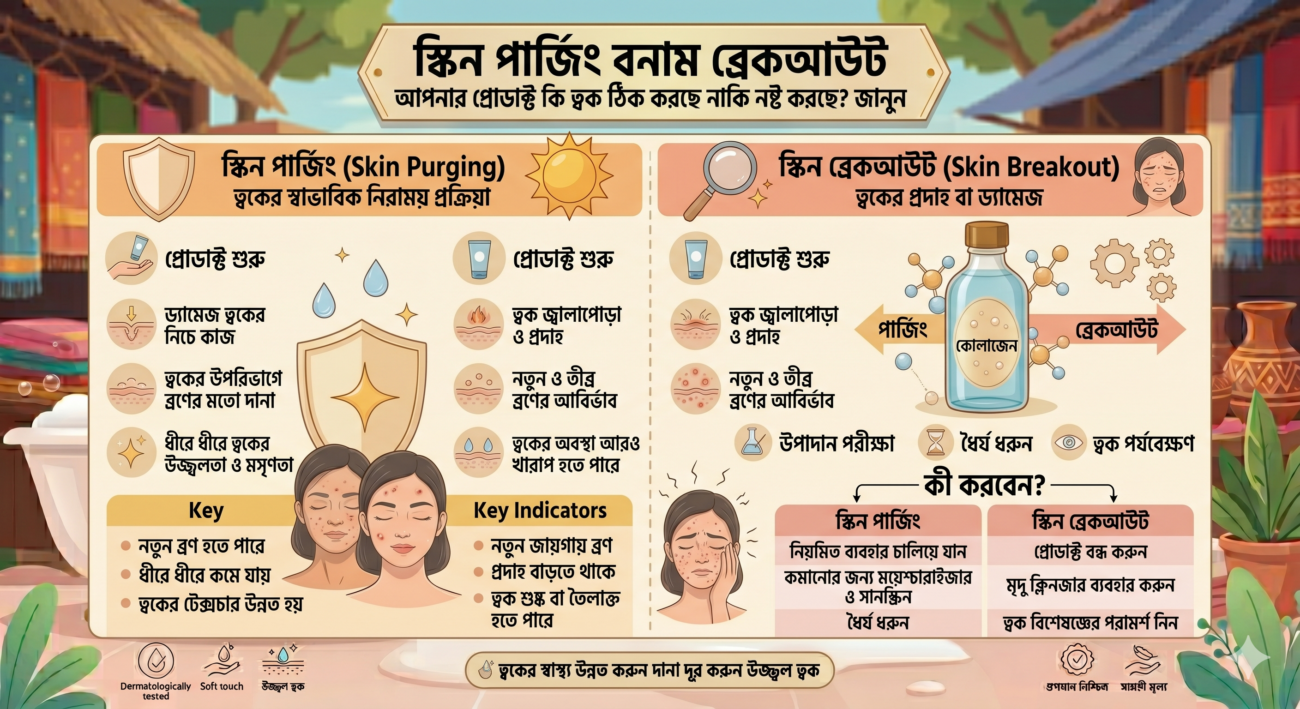
নতুন স্কিনকেয়ার প্রোডাক্ট শুরু করার পর ব্রণ বেড়ে গেছে? এখন ছেড়ে দেবেন নাকি চালিয়ে যাবেন?...

কোলাজেন — অ্যান্টি-এজিং মার্কেটে এই শব্দটা সবচেয়ে বেশি ব্যবহৃত হয়। কোলাজেন ক্রিম, কোলাজেন সাপ্লিমেন্ট, কোলাজেন...

চোখের চারপাশে বা গালে ছোট ছোট শক্ত সাদা দানা দেখা দিচ্ছে? এগুলো হয়তো মিলিয়া। ব্রণের...



 Serums and Treatments
 Moisturizer
 Cleanser
 Face Mask
 Acne Treatment Products
 Sun Protection
 Skin Care Sets & Kits
 Eye Care Products
 Lip Care Products
 Toners & Exfoliators
 Active Ingredient Products
 Body Butter
 Men’s Face Wash
 Moisturizer for Men
 Men’s Hair Care Products
 Brightening Skincare Products
 Acne Skincare Products
 Pore Minimizing Products
 Anti-Aging Skincare Products
 Pigmentation Treatment Products
 Dehydration Skincare Products
 Blackheads & Whiteheads Treatment Products
 Bumpy Skin Treatment Products
 Blemish & Spot Treatment Products
 Dark Circles Treatment Products
 Sensitive Skin Care Products
